Buyer guide
Private Label Lip Gloss: From Formula to Tube
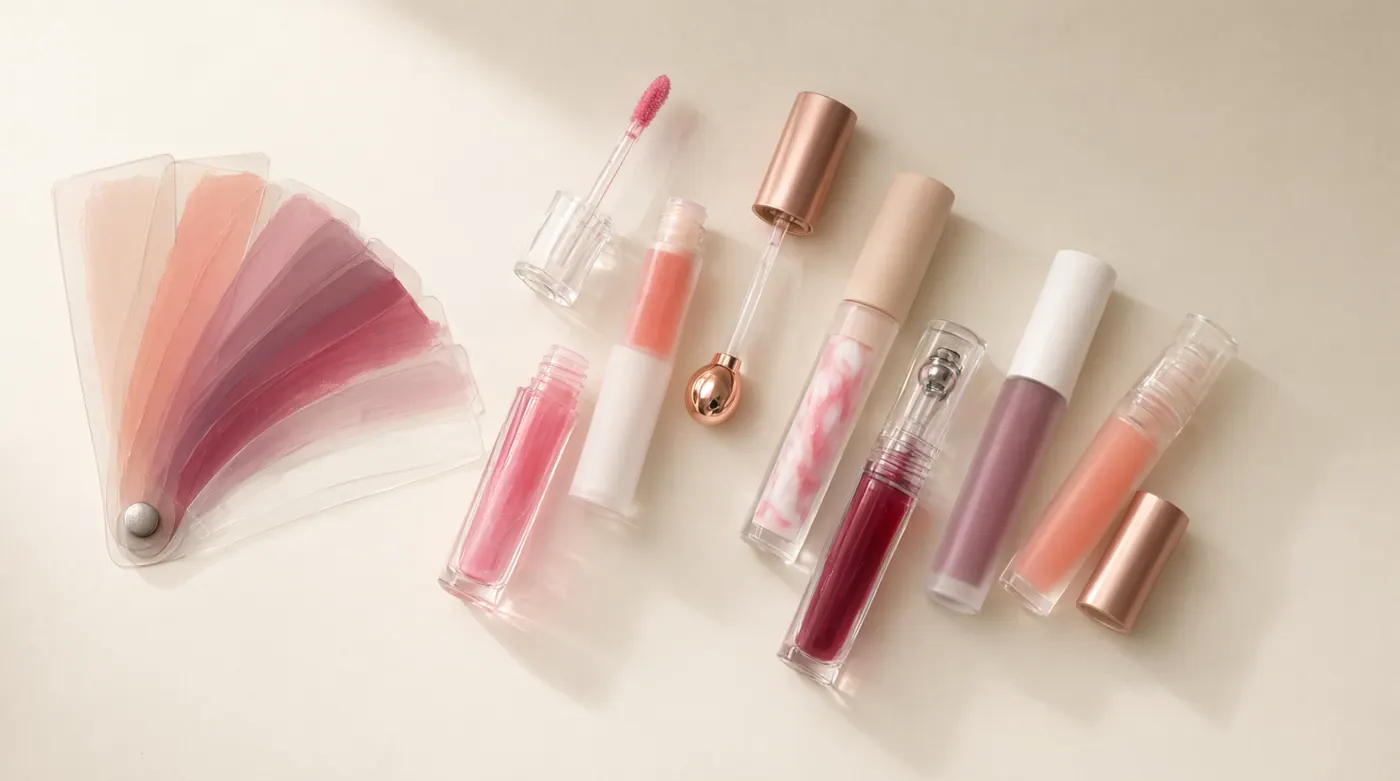
Private label lip gloss looks simple from the outside: a tube, a wand, a colour. Then you get into finishes, tackiness, flavour, tube geometry, fill weight and the paperwork your importer will ask for — and it stops being simple. Here's the whole path, formula to tube, the way we run it at Magic Color for brands launching a gloss line.
Magic Color is Jinhua Magic Color Cosmetic Co., Ltd. We've worked in color cosmetics since 2008, keep 500+ mature formulas on file, and our development teams produce over 600 new product samples a year. Lip gloss is one of the categories we run most — from clear glaze to plumping jelly — in volumes from 6,000 pieces up.
Pick the finish before you pick anything else
Finish drives everything downstream — the base, the applicator, the tube, even the label copy. Get it wrong, and no shade tweak will save the product.
Four finishes cover most briefs:
- Mirror / glass shine. High-refractive oils plus a carefully chosen film former. Spectacular on camera. Feels tackier unless you spend on the base.
- Non-sticky gloss. The one buyers ask for most. Soft, cushiony, comfortable on reapplication, slightly less wet-look shine. Our dewy non-sticky mirror glaze is a good reference point.
- Plumping / jelly. Thicker body, often with a cooling agent. Great for social content, harder to fill consistently if viscosity drifts.
- Tinted, two-tone and colour-changing formats. Fun to make, but tooling gets complex. The shade story has to read at a glance on shelf.
Texture words matter. “Non-sticky” means no drag to one brand and no tack after two hours to another. Tell us which you mean. Otherwise you'll approve a lab sample and reject the bulk.
Shade matching: get specific, not poetic
“Dusty rose, but warmer” gets you started. It isn't a spec. Bring references: Pantone chips, a competitor product, a fabric swatch, a photo with the lighting noted. Our colour team matches against the Pantone system. We refresh a colour card every year, so you work from something reproducible — not a memory of a moodboard.
Plan for it: gloss shades shift with tube thickness and base clarity. At the same pigment load, a clear base and a slightly milky base read differently. Your hero SKU must match an existing product exactly? Send the physical sample, not the hex code. We hold Pantone shade matching to a colour difference within ±2 ΔE. And we'll tell you when a target sits outside what a gloss base can hold.
Work in this order: finish, base clarity, pigment load, then shade. Reverse it and you lose weeks.
Flavour, taste and the claim on the front of the tube
Projects tend to go quietly wrong on flavour. A strawberry note smells great in the lab. Ten minutes on the lip and it can turn bitter, or fight the base's own scent. Taste and smell? Two separate briefs. Sign off both.
There's a regulatory side. Flavour components have to be declarable and cleared for your market. In the EU that means the ingredient list and safety assessment under Regulation (EC) No 1223/2009; in the US you're working to FDA and MoCRA requirements. Want a vitamin E or hydrating claim on the front? The formula has to carry the level that supports it.
Tubes, applicators and MOQs
Half the product is the tube. Shoppers judge gloss by the pack before they ever swatch it. Formats we run for private-label lip gloss projects:
- Brush-tip / doe-foot — classic, precise, best for pigmented gloss.
- Rollerball — light delivery, popular for oils and treatments.
- Squeeze tube — generous dose, good for a glossy-balm positioning.
- Special formats — dual-ended two-tone, pendant caps, spiral and layered fills. Strong unboxing, more tooling.
Materials: PP, PE, PET, PETG, AS and ABS are all in play, plus metal shells that go through salt-spray testing. Brushes are synthetic fibre, never animal hair.
MOQ is where the budget conversation actually starts. No special process? Basic models start at 6,000 pcs. Electroplating, 3D printing, silk-screen, embossing or a custom mould pushes it to 12,000 pcs. Custom component shells sit at 12,000 too. For sets, standard processes start at 3,000 sets; special processes start at 6,000 sets. That 3,000-set minimum covers standard cases, sleeves, bags and gift boxes. Price breaks: 12k / 30k / 50k / 100k. Launch plan is 5,000 units and you want a soft-touch finish? Change the finish, not the MOQ. Cheaper in time and money. Our formulas and packaging page lists the shells we already tool.
Filling at ±0.1 g in a controlled room
Fill weight quietly eats gloss margins. Overfill by half a gram across 50,000 units and you've given product away. Underfill and your net content claim is wrong — a compliance problem, not a rounding error.
Our sterile filling lines hold ±0.1 g. The room runs at 18–26 °C and 45–65 %RH, with daily ozone and UV disinfection, air showers for operators, and ozone / UV / 75% alcohol sanitising for equipment and containers. Liquid products get a screw cap, or a screw cap plus sealing gasket where the pack calls for it. All filling workshops in our current Jinhua factory are Class 100,000 GMPC cleanrooms. A new facility of about 100,000 m² with 45 lines is due to open in 2027.
Two practical notes. Viscosity drift during a long run changes dose more than the pump does, which is why content weight gets checked on patrol inspection, not just at first article. And if your tube carries decorative elements — a pendant, a two-tone cap — agree the fill line position on the physical sample before bulk starts. Retained samples from your batch go into a constant-temperature, constant-humidity room, logged by batch, and are kept until six months after the end of the product's shelf life.
Testing, claims and import paperwork
What you need depends on where it ships. Formulas can be built for EU (EC) No 1223/2009 and REACH — every raw material carries a valid REACH number, and pigments are selected against Annex IV of that regulation. For the US we formulate to FDA and MoCRA requirements. Middle East is GSO 1943/2021, Russia TR TC 009/2011, India Cosmetics Rules 2020, and ASEAN runs its own scheme. Our compliance database stays live for the markets we serve.
Testing: physical, chemical, microbial and heavy-metal tests run in-house. Every raw material arrives with a COA. Need third-party reports from SGS, Intertek or CTI? They're available per batch on request. They're not automatically bundled, so ask at quote stage if your retailer demands them.
Stability, compatibility, light, drop and fit tests run at sample stage. You get an initial report at one month and a full one at three. That timeline catches a gloss that turns grainy in a warm warehouse.
Sampling and the real timeline
Here's the honest version. Nobody should plan a launch on fantasy dates.
| Stage | Standard | Express |
|---|---|---|
| Formula development (incl. basic testing) | 14 days | 7 days (no compatibility/stability) |
| Sampling | 3–7 days | — |
| Production (order confirmed to shipment) | 45 days | 30 days |
Sampling is free; you cover the freight. Two revisions are free, further rounds are charged at cost. Quotes hold for 30 days. Payment is usually 30% deposit, 70% before shipment, by T/T or L/C. Sea freight: 30–45 days. Air: 7–15. Express: 3–7.
Add it up for a first launch with a new formula, new tube and one sampling round. About two weeks for formula, three to seven days for the sample, one approval cycle, then 45 days of production. That's roughly nine to ten weeks before it leaves the factory, plus transit. Express shortens that, but you take the basic report first and the full one later.
Unopened shelf life is 3 years, 12 months after opening. Line your retail listing dates up against that, not against the launch date.
What to send us first
Don't send a long brief. Send five things and we can quote in a day or two: the finish you want, the shade reference, the tube style or a pack photo, your target market, and your first-order quantity. The rest we work out together.
Worth saying plainly — this matters more than the unit price. A gloss that leaks at 30 °C or separates in month two costs you a reprint of the whole campaign. Pick the manufacturer who tells you when a brief is a bad idea.
Ready to start? Our lip gloss range shows the formats and finishes we already run, and you can send your brief to our team. We're at No. 299, Changfeng North Street, Jindong Economic Development Zone, Jinhua, Zhejiang, China, near Ningbo and Shanghai, and buyers are welcome to book a factory visit.
FAQ
What is the minimum order for private label lip gloss?
No special process? Basic models start at 6,000 pcs. Electroplating, 3D printing, silk-screen, embossing or a custom mould raises it to 12,000 pcs. Custom component shells are 12,000 as well. For sets, standard processes start at 3,000 sets and special processes at 6,000 sets. Price breaks: 12k, 30k, 50k and 100k.
How long does a custom lip gloss project take, brief to shipment?
Formula development takes 14 days standard — 7 days express, without compatibility and stability testing. Sampling takes 3–7 days. Production is 45 days standard or 30 days express. Add your approval cycle and transit on top.
Can you match a specific Pantone shade or an existing product?
Yes. We match against Pantone and update our colour card yearly. We hold shade matching to a colour difference within ±2 ΔE. For an exact match, send the physical product rather than a hex code, because gloss shades shift with base clarity and tube thickness. We'll flag it when a target isn't achievable in a gloss base.
What testing and compliance documents come with a lip gloss order?
Physical, chemical, microbial and heavy-metal testing run in-house. Every raw material comes with a COA. Third-party reports from SGS, Intertek or CTI are available per batch on request. Formulas can be built to EU (EC) No 1223/2009 and REACH, or to FDA and MoCRA requirements for the US. Other markets go through our compliance database.