Buyer guide
Lip Gloss Tube Options: Wand, Squeeze, Roller and Keychain Compared
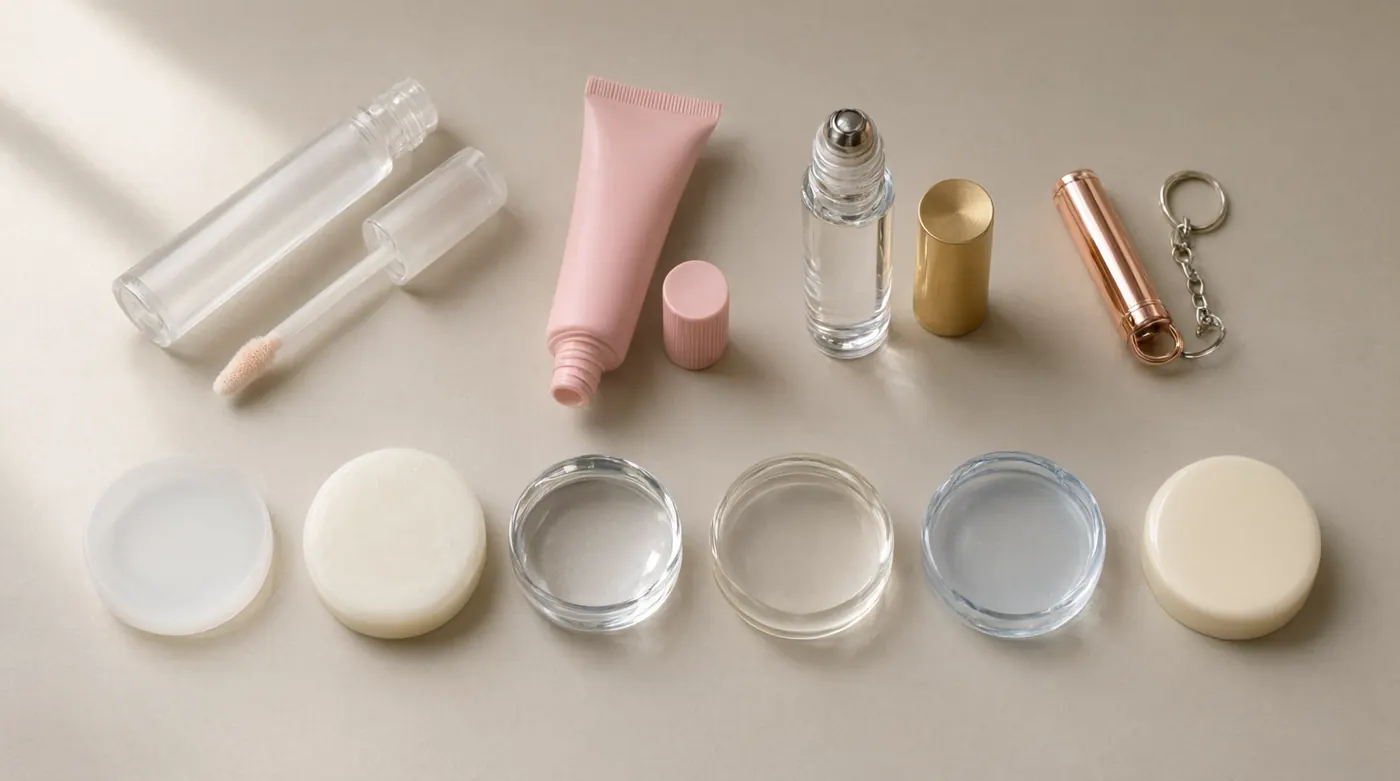
Choosing lip gloss tubes is not a small packaging decision. The tube sets how much product comes out, how the gloss feels going on, whether it survives a handbag, and how it looks in a nine-second video.
Below is a working comparison of the four formats we build most — wand, squeeze, roller and keychain — with the materials, decoration and leak testing that go with each. Use it to narrow your lip gloss brief before you ask anyone for quotes.
The applicator comes first, not the bottle
Most brand owners start with bottle shape. Start with the applicator instead. It decides your usable viscosity range, the dose per stroke, and the whole sensory impression of the first swipe. A doe-foot dipped in a thin oil feels empty. A slant tip on a thick, gummy gloss feels blocked. Match those two and the rest of the spec gets much easier.
Wand tubes: the default for a reason
Wand tubes — doe-foot, brush tip, spatula — hold most of the premium shelf, and correctly so. A doe-foot gives a repeatable dose and a controlled lay-down, which is what people expect from a gloss they paid real money for.
Bodies are typically PETG, AS or ABS, with PP for the cap, rod and wiper. The wiper is the part brands underestimate. It scrapes the rod to the right film thickness, and a cheap wiper either starves the applicator or floods the neck. Get it tooled to your formula, not to the bottle you liked in a catalogue.
Two things to watch. Thick-wall bottles show scratches and print misregistration far more than thin ones. Heavy caps stress the neck, so test drop behaviour, not just the look. A thick-wall wand build is what sits behind something like our dewy non-sticky mirror gloss.
Squeeze tubes: fast, forgiving, and easy to overfill
A soft PE or PP tube with a slant tip, a silicone applicator or a plain nozzle is the cheapest decent lip gloss packaging you can buy. Big print area. Low weight. No wiper to tune. Travel-safe by design.
Thin textures live here — lip oils, gloss-serum hybrids, tinted treatments. So do value multipacks, because the tube cost stays low at volume. The trade-off is dose control: one squeeze can be three applications, and buyers do notice. If your formula is runny, spec a smaller orifice and test it with real hands rather than a lab pipette.
Roller bottles: oils, tints and a cooling metal ball
The ball sits in a PP or ABS housing and rolls product onto the lip. Steel feels cool and premium; plastic balls are lighter and cheaper. Rollers suit thin oils and sheer tints, and they make a treatment product read as skincare.
They also leak at the ball seat once things get hot, and an exposed ball picks up lint in a bag. Thick shine glosses don't dispense well through a roller. Choose it when the formula is thin and the story is care, not colour.
Keychain tubes: small format, big attachment problem
Keychain gloss sells as a gift, an add-on, an impulse buy, and it fits teen and tween lines naturally. Build it as an ABS or AS shell around a small PET or PP inner bottle, with a moulded loop or silicone strap — the shape behind pieces like our double-layer gloss with heart pendant.
The tube is rarely what fails. The attachment is. Pull-test the loop, drop the whole unit on tile, and stress the split ring you source separately. A keychain that snaps off in a school bag kills repeat purchase. Fill volume is small, so cost per gram climbs, and label space runs out fast. Print or emboss the shell instead of fighting for a 20 mm label.
Materials: PP, PE, PET, PETG, AS and ABS
Pick by wall thickness, clarity and what's in your formula. Nothing else.
- PP — the workhorse. Caps, rods, wipers, roller housings, squeeze tubes. Good chemical resistance, limited clarity, low cost.
- PE — soft and squeezable, in LDPE and HDPE grades. Matte, slightly waxy feel; not a glass-look material.
- PET — clear and rigid in straight walls. Thinner feel, and some high-solvent formulas will stress it.
- PETG — thick-wall clarity and gloss, the usual pick for premium wand tubes. Scratches more easily than PET.
- AS — hardest and glossiest of the clear plastics, great for heavy caps and luxury bottles. Brittle, and it chips.
- ABS — impact-resistant, plates and prints beautifully, opaque only. The default for shells and keychain bodies.
On price, plastic sits below acrylic and metal, with recycled or eco grades a little higher. Ask for two options at different points on that ladder. The gap in perceived value is usually bigger than the gap in cost.
Decoration that survives a handbag
Silk screen, hot stamping, UV varnish, 3D printing, embossing and electroplating are all in play. What separates a good sample from a good production run is adhesion on curved surfaces and rub resistance against keys and coins.
Ask for a print adhesion check, not a photo. We test printing adhesion on tubes, label tack and plastic-part separation force during incoming and finished-goods inspection, because those are the failures that show up as a complaint three weeks after launch.
For colour, Pantone shade matching is held to a colour difference within ±2 ΔE against a physical master, approved under daylight and again under shop lighting. Approve the master, not the screen.
Air-tightness and leak testing: where cheap tubes fail
Lip gloss is pigment in oil, sometimes with a volatile carrier. Given heat and time, it finds every weak thread and every badly seated ball. A slow leak shows up as a greasy carton on a retail shelf — the kind of thing a buyer remembers at the next range review.
So we test the construction, not just the fill. Tube air-tightness, cap fit, drop, simulated transport, separation force on plastic parts, print adhesion. At sample stage we add stability, compatibility and light testing, and a new component doesn't get a production order until the evaluation report is signed off.
On the line, closed filling with automated dosing to ±0.1 g, held at 18–26 °C and 45–65 %RH. Liquid and cream products close with a screw cap, or a screw cap plus sealing gasket where the formula needs it. Every batch is retained in a constant-temperature, constant-humidity sample room with its own traceability file until six months after the end of the product's shelf life, and third-party SGS, Intertek or CTI reports are available per batch on request.
All filling workshops in the current Jinhua factory are Class 100,000 GMPC cleanrooms. A new facility of about 100,000 m² with 45 lines is planned to open in 2027, which matters once your volumes outgrow what the current 30-plus lines can slot in.
Side-by-side comparison
| Format | Typical body materials | Applicator | Best for | Main risk |
|---|---|---|---|---|
| Wand | PETG, AS, ABS (PP cap, rod, wiper) | Doe-foot, brush tip, spatula | Thick, cushioned, high-shine gloss | Wiper tuning; neck stress from heavy caps |
| Squeeze | PE, PP | Slant tip, silicone tip, nozzle | Oils, tints, serum-gloss hybrids, multipacks | Over-dosing; cap-area leakage |
| Roller | PET, PP body; PP/ABS housing | Steel or plastic ball | Thin treatment oils, sheer tints | Ball-seat leaks in heat; exposed ball |
| Keychain | ABS/AS shell, PET/PP inner bottle | Doe-foot or tip | Gifting, add-ons, teen and tween lines | Attachment and drop failure |
MOQ, lead times and the 12,000 question
Stock models start at 6,000 pcs. A custom shell or special process — your own mould, electroplating, 3D printing, silk screen, embossing — is 12,000 pcs. Price breaks land at 12k, 30k, 50k and 100k, so model the gap between 12,000 and 30,000 before you commit to tooling.
Timing, roughly: formula development 14 days (7 express), samples 3–7 days and free apart from freight with two free revisions, production 45 days standard or 30 express, quotes valid 30 days. Payment is usually 30% deposit and 70% before shipment, by T/T or L/C.
One blunt opinion. If you're launching four shades, don't tool a custom tube for all four. Launch two in a stock tube, prove sell-through, then spend the tooling money on the shade that earned it. Wholesale buyers care about unit cost far more than your cap design — right up until the cap leaks.
Labeling and compliance, briefly
Formulas are built to EU (EC) No 1223/2009 and REACH, with EN-71 for kids' items, and to FDA and MoCRA requirements for the US. That's the formula side. The label side belongs to your market's rulebook: the European Commission's cosmetics rules and the FDA's cosmetics labeling requirements are the two to read before artwork sign-off.
For roller and keychain formats, add mechanical checks. Small parts, attachment strength and child appeal all draw extra scrutiny on kids' lines, and retailers ask earlier than regulators do.
Send a brief with fill volume, formula texture, target market and order quantity, and we'll come back with two or three tube options priced at your volume. Contact the team when you're ready. Private label lip gloss moves faster when the tube is settled early.
FAQ
Which lip gloss tube works best for a thick, non-sticky formula?
A wand tube. Use a PETG or AS body with a doe-foot applicator, and tune the wiper to your viscosity so each pull carries a repeatable dose. Thin squeeze tubes tend to over-deliver thick formulas, and rollers simply won't move them.
What is the MOQ for custom lip gloss tubes?
Basic stock models start at 6,000 pcs. Custom component shells and special processes — own mould, electroplating, 3D printing, silk screen, embossing — are 12,000 pcs. Price breaks apply at 12k, 30k, 50k and 100k pieces.
How do you check a tube for leaks and air-tightness?
Tube air-tightness testing, cap fit, drop and simulated transport tests, plastic-part separation force and print adhesion run during incoming and finished-goods inspection. Sample stage adds stability, compatibility and light testing. Third-party reports from SGS, Intertek or CTI are available per batch on request.
Can I get private label lip gloss with my own artwork and Pantone colours?
Yes. We match Pantone shade to a colour difference within ±2 ΔE against a physical master and decorate with silk screen, hot stamping, UV, 3D printing or embossing. Samples take 3–7 days and are free apart from freight, with two free revisions.