Buyer guide
What Drives Lip Gloss Production Cost? 6 Factors Buyers Can Control
What Drives Lip Gloss Production Cost? 6 Factors Buyers Can Control
The lip gloss manufacturer cost you get quoted rarely depends on one thing. Two buyers can order the same 12,000 tubes and pay noticeably different unit prices, because a price is assembled from decisions made long before the purchase order is signed. Some of them you can't touch — resin prices, freight rates, the exchange rate on the day you pay. Most you can. Below are the six that move a lip gloss quote the most, the four pricing principles behind our own numbers, and what you get from us before you commit to anything.
1. Quantity tiers: the unit price falls in steps, not a curve
Volume is the biggest lever — and it doesn't move in a straight line. Tooling, print plates, line changeover and quality checks are fixed costs; they don't shrink with volume. Run 6,000 units and every tube carries a heavy share of them. Run 50,000 and the same costs almost disappear into the unit price.
Our MOQs follow that logic. A basic model with no special process starts at 6,000 pcs. Need electroplating, 3D printing, silk-screen, embossing or a custom mould? That starts at 12,000 pcs. Custom component shells sit at the same 12,000. Price breaks land at 12,000, 30,000, 50,000 and 100,000 pcs.
Sets work differently. A gift box is priced as an assembly, not as a single item. Sets with standard processes — standard cases, sleeves, bags and gift boxes — start at 3,000 sets; sets with special processes start at 6,000 sets.
One blunt note. Ordering 6,000 to test the market and then reordering 30,000 three weeks later is usually the most expensive way to buy lip gloss. If your forecast is roughly double the MOQ, ask for pricing at both tiers before you decide — the answer often changes the plan. Browse the current lip gloss range to see which formats sit in the basic, no-special-process band.
2. Process complexity: every extra pass through the line costs something
Filling a gloss looks simple from the outside. Inside the current Jinhua factory, every filling workshop is a Class 100,000 GMPC cleanroom. That means controlled temperature and humidity. It means automated dosing held to ±0.1 g. Those controls keep a 5,000-unit run consistent with the sample you signed off. They cost money to run, too — and the cost per unit drops as the run gets longer.
Then come the add-ons. Electroplating a cap. Embossing a logo into a lid. A two-tone or dual-ended format that needs more than one filling step and a different assembly sequence. None of this is hard for a factory that runs it every week, but each one adds stations, time and QC checks — and pushes the MOQ up to 12,000.
Formula work is the other half. A custom formula takes 14 days standard or 7 days express. The express route skips compatibility and stability testing — you may or may not want to accept that. Look at formulas and packaging together, because they interact. A thicker texture may not flow in the slim tube you had in mind.
3. Material grade: plastic < acrylic < metal
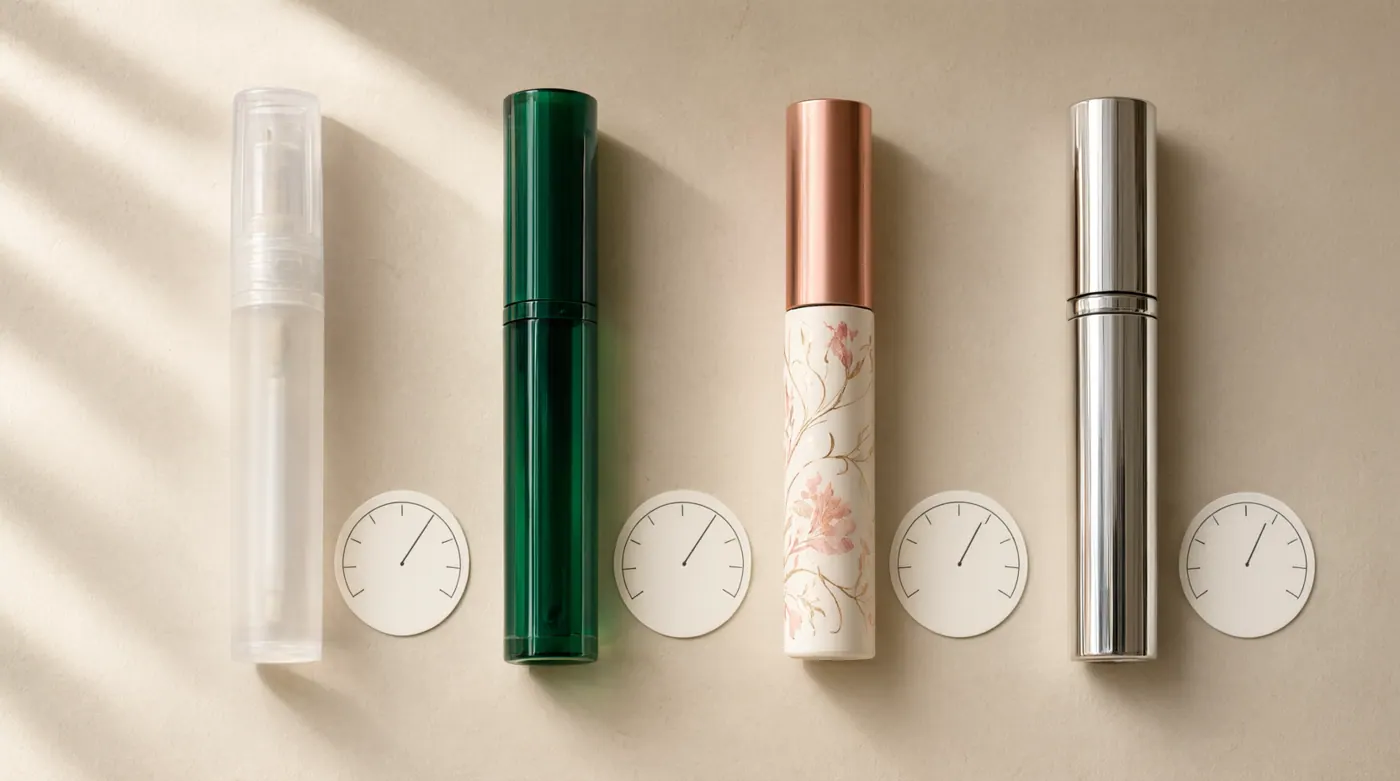
The simple rule: plastic costs least, acrylic sits in the middle, metal costs most. That order holds across the shells we mould. On the plastic side: PP, PE, PET, PETG, AS and ABS. On the metal side: aluminium, salt-spray tested so the finish survives a real handbag.
Eco materials bend the rule slightly upward. Recycled and degradable options usually cost a little more than the standard resin they replace, and that premium doesn't vanish at high volume. Worth paying? Sometimes. If your brand story is built on sustainability, yes. If it's built on price and shelf pop, you may get more from decoration.
Material grade applies inside the tube too — pigment load, film formers and specialty actives all move the fill cost. At low volumes, though, the shell is usually the bigger lever. It's also the part your customer physically holds.
4. Spec deviation: how far your idea sits from a standard component
This is the factor buyers underestimate. The closer your spec is to a standard bottle, cap and brush, the lower the price. No new tooling. No new QC criteria. Known yields. Move away from standard and cost climbs in small increments: a custom mould, a non-standard diameter, a cap that needs a new inner liner, a Pantone shade matched to within ±2 ΔE under controlled light.
We hold 500+ mature formulas and match Pantone shades to within ±2 ΔE, so many custom lip gloss briefs are really a standard base plus a colour and a decoration. That's the cheap path, and there's no shame in it.
Compliance sits here as well. Sell into the EU and the product has to meet (EC) No 1223/2009 before it goes on the market, which means a safety assessment, a product information file and label wording that survives scrutiny — the European Commission cosmetics pages set out the framework. In the US it's FDA and MoCRA requirements. Testing and documentation carry real cost. They aren't optional, and they shouldn't show up as a surprise line item.
5. Tube decoration: where two quotes quietly diverge
Two suppliers can quote the same shell and the same fill — and still land on very different numbers. Decoration is usually why. Options include offset, silk-screen, hot stamping, UV, 3D printing and embossing. Each one has a setup cost, a per-unit cost, and a minimum run length that suits it.
What matters: how many colours, how much surface you cover, how many passes it takes, and whether the print wraps around the tube or sits on one panel. A four-colour wrap on a curved tube is a different job from a one-colour logo on a cap.
Ask for decoration as its own line in the quote. Then ask what a simpler version would cost. Drop one colour. Shrink the print area. Switch hot stamp to silk-screen. This matters more than the headline unit price. A gloss that costs a few cents less per piece but arrives with a smudged print run isn't cheaper.
6. Packaging, packing and freight terms
Secondary packaging is easy to forget and hard to ignore on the invoice. A printed gift box, a custom sleeve, a five-layer export carton with foam or EPE inside — each is a separate purchase with its own MOQ. Build a wholesale lip gloss programme for retail and the box can easily cost more than the gloss inside it.
Freight terms decide who pays for what after the factory gate. FOB, CIF and DDP put very different numbers on your landed cost, and the ICC's Incoterms rules define exactly where cost and risk transfer. Our reference transit times: sea 30–45 days, air 7–15, express 3–7, land 10–20 after customs. A DDP quote that looks high may still be the cheapest landed option once you stop paying a forwarder separately.
Our four pricing principles, short and unglamorous
Everything above collapses into four rules we quote by:
- Order quantity. Bigger run, lower unit price.
- Process complexity. Simpler wins — fewer steps, fewer stations, lower price.
- Material grade. Plastic below acrylic, acrylic below metal; eco materials a little higher.
- Spec deviation. The closer to a standard spec, the lower the price.
That's it. No secret formula, no mystery fee. When a quote comes back higher than you expected, one of these four is usually the reason — and three of them are yours to change.
Before you order, samples are free. You cover the freight only, revisions are free twice, and turnaround runs 3–7 days. Quotes stay valid for 30 days, which is long enough to take a decision to your team and short enough that resin and freight movements don't turn the number into fiction. Standard production is 45 days from confirmation, 30 days on the expedited route. Payment is usually 30% deposit and 70% before shipment, by T/T or L/C.
As a lip gloss manufacturer we'd rather explain the build-up than defend a number you can't unpack. Start with the wholesale terms — or send us the brief and let us quote it properly.
FAQ
What is the minimum order for custom lip gloss?
A basic model with no special process starts at 6,000 pcs. Electroplating, 3D printing, silk-screen, embossing or a custom mould? Those start at 12,000 pcs. Custom component shells are also 12,000 pcs. Gift sets are quoted separately: sets with standard processes — standard cases, sleeves, bags and gift boxes — start at 3,000 sets; special-process sets start at 6,000 sets.
Why is a 30,000 pcs quote cheaper per piece than a 12,000 pcs quote?
Fixed costs — tooling, print plates, line changeover, quality checks — get spread over more units. Our price breaks sit at 12,000, 30,000, 50,000 and 100,000 pcs. If your forecast sits between two tiers, ask for both at once.
Are samples really free?
Yes. Samples are free; you pay the freight only. Turnaround is 3–7 days. You get two free revisions, and the quotation we send afterwards is valid for 30 days.
Which packaging material keeps cost down without looking cheap?
Plastic costs least, acrylic sits in the middle, metal costs most. Recycled or degradable materials run slightly above the standard resin they replace. At low volumes, spend on decoration rather than shell material — it often gives more visible value per unit.