Buyer guide
How to Start a Lip Balm Line with a Private Label Manufacturer
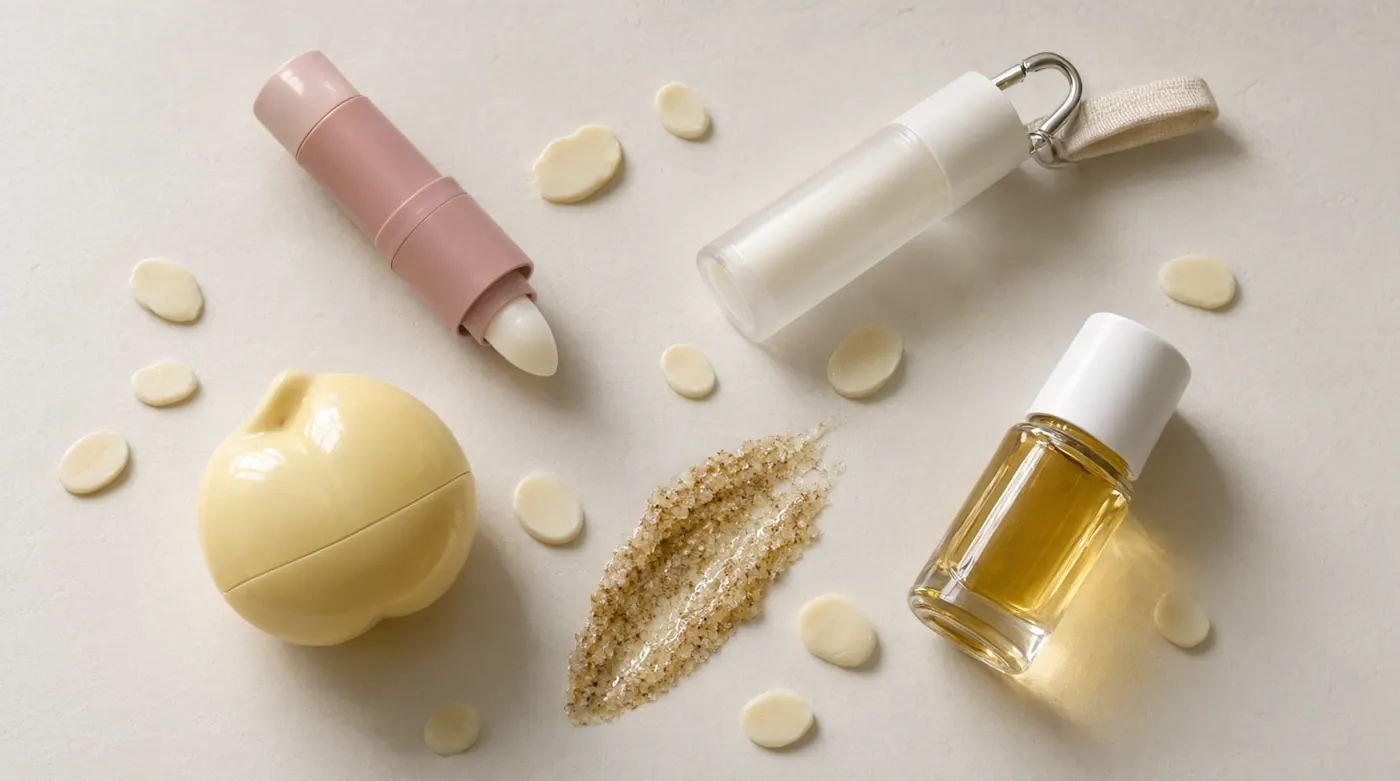
A private label lip balm manufacturer shapes your launch more than your logo does. Balm looks easy — wax, oil, butter, a tube. Then you approve artwork and find out your fragrance-free claim needs an allergen declaration, the keychain tube you loved carries a 12,000-piece minimum, and the stability report is still three weeks out. We have been making color cosmetics since 2008, lip products among them. Here is the order we would run your lip balm line in.
Pick the format before the flavour
Founders arrive with a flavour and a colour. Lovely. Start with the format instead, because each one drags different filling, testing and packing costs behind it.
- Stick balm. Anhydrous, hot-filled, twist-up or clip-on tube. Cheapest to produce, cheapest to ship, easiest to get right at low volume. If this is your first SKU, it should probably be this one — our lip balm range covers the standard builds.
- Scrub. Sugar or salt held in a wax or emulsion base. Two routes: a stick, like this aloe lip scrub stick, or a paste in a jar or tube such as our natural sugar lip scrub. Particle size and suspension stability decide whether it works.
- Mask. Usually an emulsion or a gel, so now you need preservative logic and microbial testing that a pure wax stick never asks for. Multi-layer builds exist too; this 3-layer two-tone lip mask is half formula, half packaging.
- Oil or serum. Thin, glossy, dropper or doe-foot. Leak risk climbs and the closure earns its money. See the nourishing lip oil and the glass glow lip serum for the two common builds.
One blunt opinion: launch one format, not four. A brand with a great balm beats a brand with four average ones every time. Add the scrub next season, once reviews are in.
Claims live in documents, not on artwork
Vegan. Fragrance-free. Cruelty-free. Sensitive-skin friendly. Four words, four documents. If your tube prints it, somebody has to prove it later — to a buyer's auditor, a customs officer, a marketplace compliance bot.
Vegan is the one that surprises people. No animal-derived material anywhere in the formula, which rules out beeswax, lanolin and carmine-based tints. A vegan balm usually shifts to candelilla, sunflower or rice bran wax. That swap changes texture. So approve the texture, not just the claim.
Fragrance-free has two traps. A formula can be fragrance-free and still carry a masking fragrance — not the same thing at all. And in the EU, fragrance allergens present above the labelling threshold must be declared, so the allergen picture has to be settled before artwork, not after. Ask for the allergen declaration as its own document, separate from the INCI list.
On cruelty-free: we print it where the file supports it. A third-party animal-testing logo is a different matter. We only print marks we actually hold, and we hold none of those, so it stays off the artwork. Same discipline in the US, where we formulate to FDA and MoCRA requirements and leave it at that. No regulator hands out a pre-market approval stamp for a lip balm. A supplier claiming one has just told you something useful about their paperwork.
Market rules, short version. In the EU, Regulation (EC) No 1223/2009 puts the duty on a Responsible Person established inside the EU, who keeps a Product Information File and notifies the product before sale. In the US, the Modernization of Cosmetics Regulation Act of 2022 (MoCRA) brought facility registration, product listing and adverse event reporting. Neither one is end-of-project admin. Both are week-one admin.
And if your balm carries a sustainability story, check the palm-derived ingredients. Cetyl alcohol, plenty of emulsifiers and several waxes start at palm. RSPO supply-chain certification is the usual evidence route — Magic Color holds RSPO among its system certificates.
Twist-up, keychain or cartoon tube
Tube choice moves your unit cost further than the formula does. A round twist-up in PP is a catalogue shell. A keychain balm or a moulded cartoon character is a tool, and tools come with minimums.
Our lip balm shells span twist-up tubes, keychain tubes and cartoon shapes — PP for the standards, silicone for the character builds. This lip balm set with hooks shows how much a clip-on format can carry on its own as a gift or impulse SKU. Catalogue shells start at 6,000 pcs. Electroplating, 3D printing, silk screen, embossing or a custom mould push that to 12,000 pcs, and a fully custom component shell lands at 12,000 too. Price breaks sit at 12k, 30k, 50k and 100k.
Decoration is where a cheap tube starts looking like a brand: offset, silk screen, hot foil, UV, 3D print, emboss. We match Pantone to within ±2 ΔE and hold colour across reorders. That matters more than the unit price the first time a restock arrives a shade off.
Filling and sealing: where balm breaks
Balm is an oil-wax system, and oil-wax systems are fussy. We run low-temperature milling with constant-temperature emulsifying, then cool on a gradient so the stick doesn't crack or bloom. Filling happens closed and controlled: automated dosing at ±0.1 g, held at 18–26 °C and 45–65 %RH.
Sealing splits by format. Wax sticks get a flush finish with no visible seam, because a seam is exactly where a balm snaps inside a handbag. Liquid oils get a screw cap, or a screw cap plus a gasket, because thin oil will find any gap in transit. Before the bulk run we drop-test, leak-test and check formula-to-pack compatibility. Skip that and a pallet of 12,000 tubes becomes an expensive lesson.
Testing, and the five documents to ask for
Our internal lab covers physical and chemical parameters, microbial counts and heavy metals. Third-party reports from SGS, Intertek or CTI are available per batch on request, and every raw material arrives with a COA on file. At sample stage we run stability, compatibility, light, drop and fit testing — a preliminary report at one month, the full one at three.
Ask any lip balm supplier for five things before you sign: the INCI plus allergen declaration, a stability report, a microbial report, the heavy metal statement, and COAs for the main waxes. If the allergen declaration is a problem, walk. Planning a sensitive-skin claim? Back it with irritation and sensitisation testing and keep patch-test advice on pack. “Suitable for sensitive skin” is defensible. “Safe for all skin types” is not.
Retained samples sit in a constant-temperature, constant-humidity room, logged by batch, and are kept until six months after the end of the product's shelf life. When a complaint lands, it gets checked against the batch itself rather than somebody's memory of it.
MOQ, timeline and cash flow
Numbers, so you can plan a first order like an adult.
| Stage | Standard | Express |
|---|---|---|
| Formula development | 14 days | 7 days (no compatibility or stability testing) |
| Samples | 3–7 days, free, you pay freight, 2 free revisions | — |
| Production | 45 days from order confirmation | 30 days, full report follows |
| Payment | 30% deposit / 70% before shipment, T/T or L/C | — |
MOQ is 6,000 pcs on basic shells and 12,000 pcs once special processes or custom tooling are in play. Quotes hold for 30 days. After customs, freight runs 30–45 days by sea to North America and Europe, 7–15 days by air, 3–7 days by express courier.
An honest planning note. The 45-day production clock starts when formula and packaging are both approved — not when you send the enquiry. Brands that sign off artwork in week two tend to hit their shelf date. Brands that sign off in week nine don't.
How to brief a lip balm manufacturer
Send five lines and you'll get a usable quote instead of a lazy range.
- Format and finish — stick, scrub, mask or oil; glossy, matte or tinted.
- The claims you intend to print, and the market you're selling into.
- Tube type, material and decoration reference.
- Fill weight and first-order volume.
- Launch date, counted backwards.
Magic Color runs 30+ automated production lines today, automation above 70%, 500+ mature formulas and 600+ new development samples a year. All filling workshops in the current Jinhua factory are Class 100,000 GMPC cleanrooms. A new facility of about 100,000 m² with 45 lines is due to open in 2027. System certificates: GMPC, ISO 22716, BRCGS, SMETA, BSCI and RSPO.
Want the packaging side mapped before the formula? Start with formulas and packaging. Ready to price a first run? Contact us with that five-line brief. Samples are free — you cover the freight — and you'll know inside two weeks whether the texture works on lips or only on paper.
FAQ
What is the minimum order quantity for a private label lip balm?
6,000 pcs for basic catalogue shells with no special decoration. Electroplating, 3D printing, silk screen, embossing, custom moulds or a fully custom component shell move the minimum to 12,000 pcs. Price breaks apply at 12k, 30k, 50k and 100k.
How long does it take to launch a lip balm line?
Formula development takes 14 days (7 days express, without compatibility and stability testing), samples 3–7 days, and production 45 days from order confirmation (30 days express). Then add shipping: 30–45 days by sea, 7–15 days by air, 3–7 days by express.
Can you make a vegan or fragrance-free lip balm?
Yes, both, and both are confirmed in documentation rather than only on the pack. Vegan means no beeswax, lanolin or carmine anywhere in the formula, so we swap to plant waxes. Fragrance-free means no added fragrance and no masking fragrance, with the allergen declaration supplied alongside the INCI list.
What testing comes with a lip balm order?
Internal physical, chemical, microbial and heavy-metal testing, plus stability, compatibility, light, drop and fit tests at sample stage (preliminary report at one month, full report at three). Third-party reports from SGS, Intertek or CTI are available per batch on request, and every raw material has a COA on file.